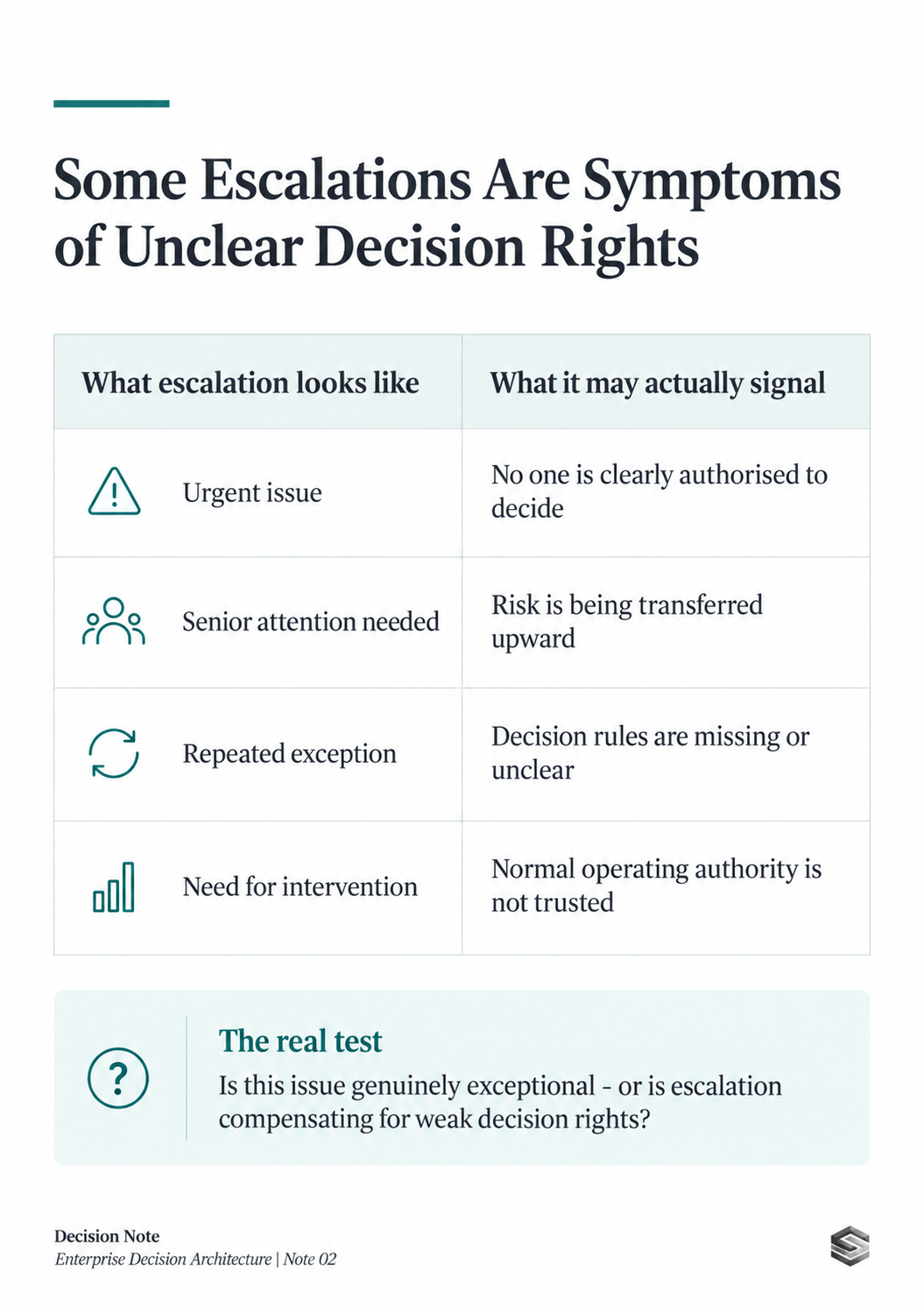
Escalations are usually treated as signs of urgency. Sometimes they are. But in many organisations, repeated escalation is not a signal that the issue is exceptional. It is a signal that decision rights are unclear.
When people do not know who can decide, they escalate. When they know who can decide but do not trust that the trade-off will be supported, they escalate. When the downside of being wrong is personal but the upside of moving fast is organisational, they escalate.
This makes escalation a useful diagnostic in enterprise decision architecture.
The question is not only: why was this escalated? The deeper question is: what decision was the system unable to absorb at the right level?
Some escalations reveal missing authority. Some reveal missing criteria. Some reveal unresolved risk ownership. Some reveal a culture where people are allowed to execute but not allowed to make judgement calls. Some reveal that leadership has unintentionally trained the organisation to seek approval for anything that may later be questioned.
A better review of escalations should therefore separate true exceptions from decision-right failures.
True exceptions deserve senior attention. Decision-right failures deserve system repair. Without that distinction, leadership becomes the permanent routing layer for decisions the organisation should have learned to handle.
An escalation log is not only a workload tracker. It is a map of where the organisation has not yet designed authority clearly enough.