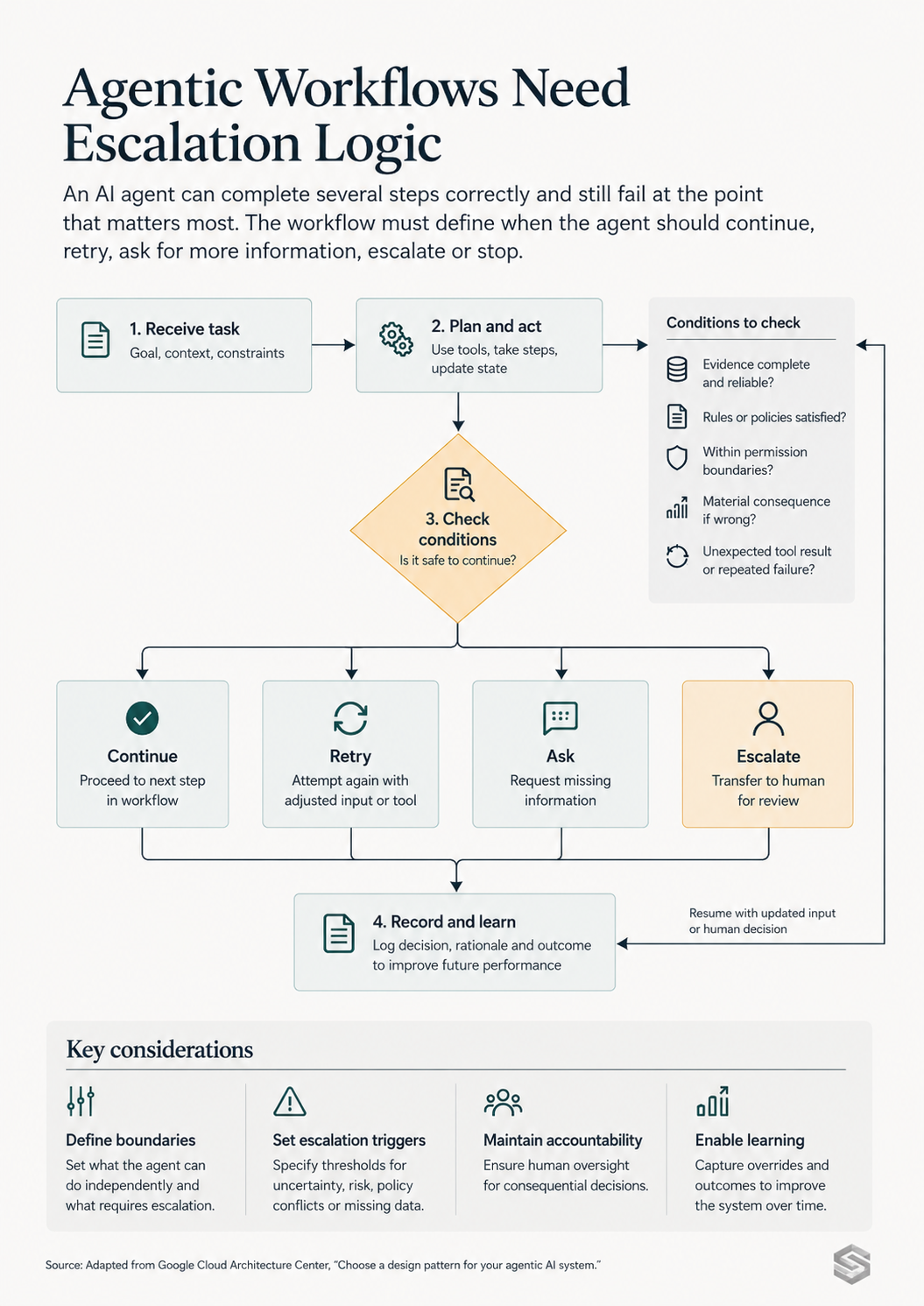
An agentic workflow is not ready for enterprise use just because it can complete a task.
It also needs to know when to stop.
That is where many designs are still immature. We test whether the agent can search, reason, call tools, draft, update and complete the path. But enterprise work also requires escalation logic: when confidence is low, when evidence is missing, when policy boundaries are crossed, when the action affects a customer, when value or risk exceeds a threshold, or when ownership is unclear.
Without escalation logic, autonomy can become fragility.
The system may keep trying when it should ask. It may call another tool when it should pause. It may produce an answer when the right response is a controlled handoff. It may hide uncertainty behind fluent execution.
A useful design question is:
What conditions require the agent to recommend, execute, escalate or stop?
This should not be left to a generic human-in-the-loop statement. The escalation path has to be designed into the workflow: trigger, reason, owner, evidence packet, SLA, audit trail and learning loop.
The point is not to make agentic systems timid. The point is to make autonomy governable.
Enterprise-grade agentic AI will not be defined only by what it can do independently. It will be defined by whether it knows the boundary between action and escalation.