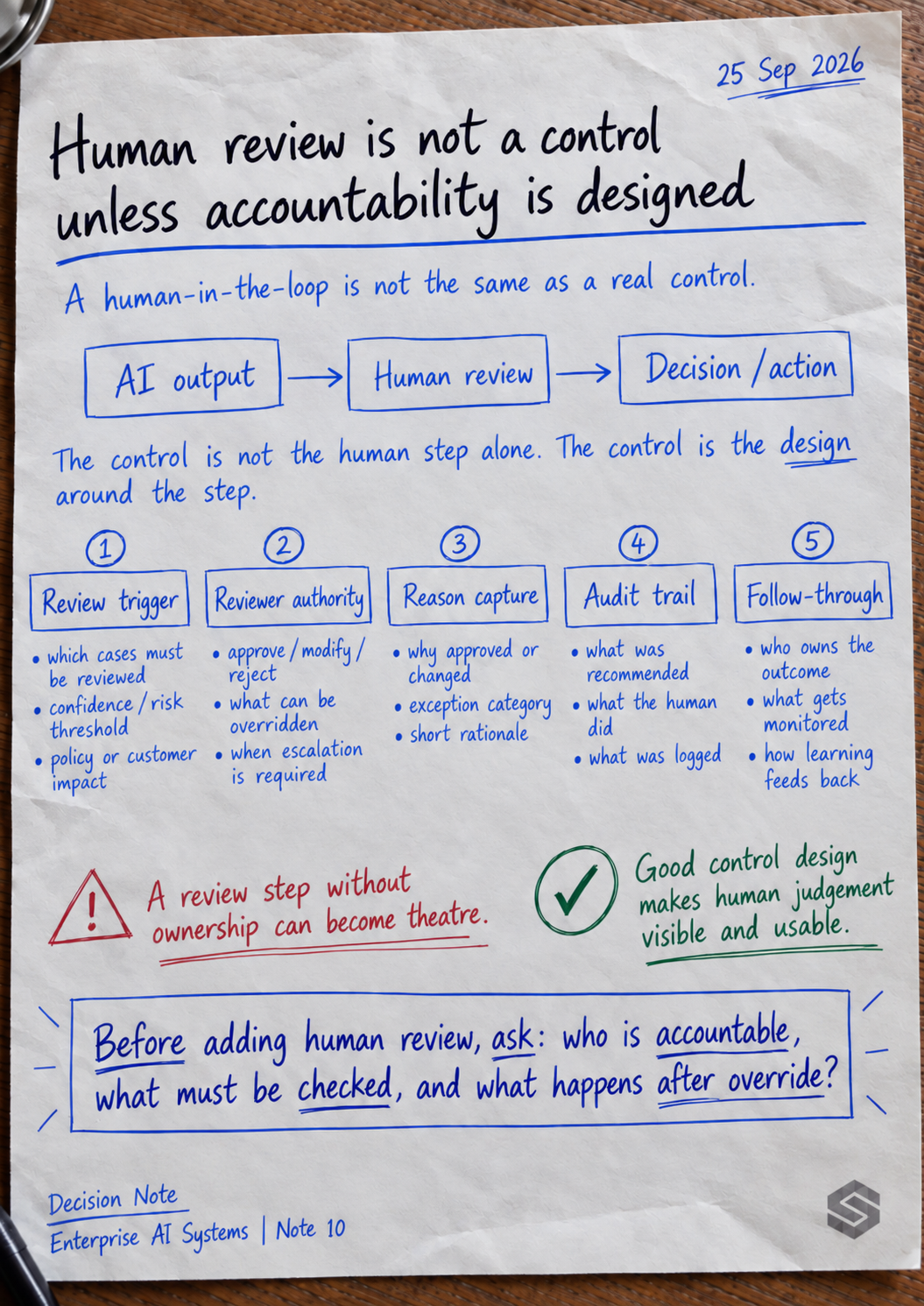
Many enterprise AI systems become more acceptable once a human review step is added. The phrase sounds reassuring. It suggests that the organisation has retained judgement, responsibility and control.
But human review is not automatically a control.
A reviewer who does not know what they are accountable for may become a rubber stamp. A reviewer without clear criteria may rely on intuition. A reviewer under time pressure may approve what looks reasonable. A reviewer who cannot see the evidence chain may check language quality rather than decision quality.
This is why human-in-the-loop design is weaker than it sounds unless the loop has accountability built into it.
The real design question is not: is there a human review step? The better question is: what exactly is the human expected to judge?
Are they checking factual grounding, business relevance, policy compliance, risk exposure, customer impact, exception handling or final decision readiness? Can they override the AI? Must they record why? Does the system learn from the override? Is the reviewer accountable for approval, or only for checking that a process was followed?
Without these answers, human review can become control theatre. It creates the appearance of oversight while leaving the real judgement boundary undefined.
A good AI workflow does not insert a human merely to make the system feel safer. It designs the human role with enough clarity that review becomes a decision control, not a comfort layer.