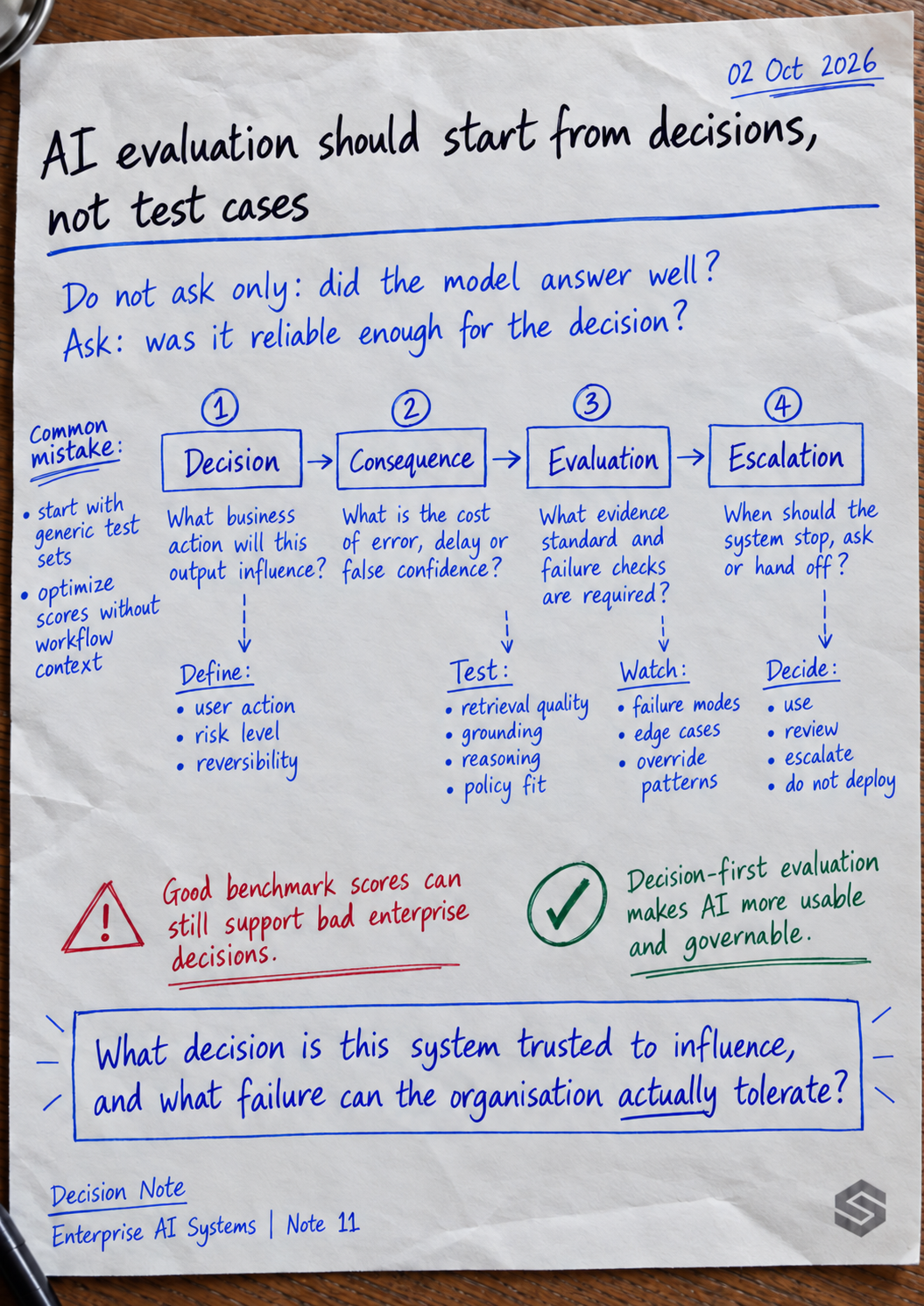
Most AI evaluation begins with test cases. That is necessary, but it is not sufficient for enterprise use.
A model can answer test questions well and still be unsafe, irrelevant or unreliable inside a real workflow. The enterprise question is not only whether the answer is correct. It is whether a decision can responsibly rely on that answer.
That changes how evaluation should be designed.
For a customer-facing summary, the evaluation may need to test factual grounding, tone, missing context and escalation triggers. For a credit or risk recommendation, it may need to test evidence quality, policy fit, exception handling and downside visibility. For a procurement insight, it may need to test whether the recommendation is commercially useful, operationally executable and traceable to source signals.
The test case is only the starting point. The real evaluation object is the decision situation.
A useful diagnostic is to ask: what bad decision could this AI output cause if it looks reasonable but is wrong, incomplete or overconfident?
That question moves evaluation away from generic accuracy and toward enterprise reliability. It forces teams to define acceptable error, confidence thresholds, human review boundaries, escalation logic and post-deployment monitoring.
Good AI evaluation does not only ask whether the system produced the right answer. It asks whether the organisation knows when to rely on it, when to challenge it and when to stop it from influencing the decision.