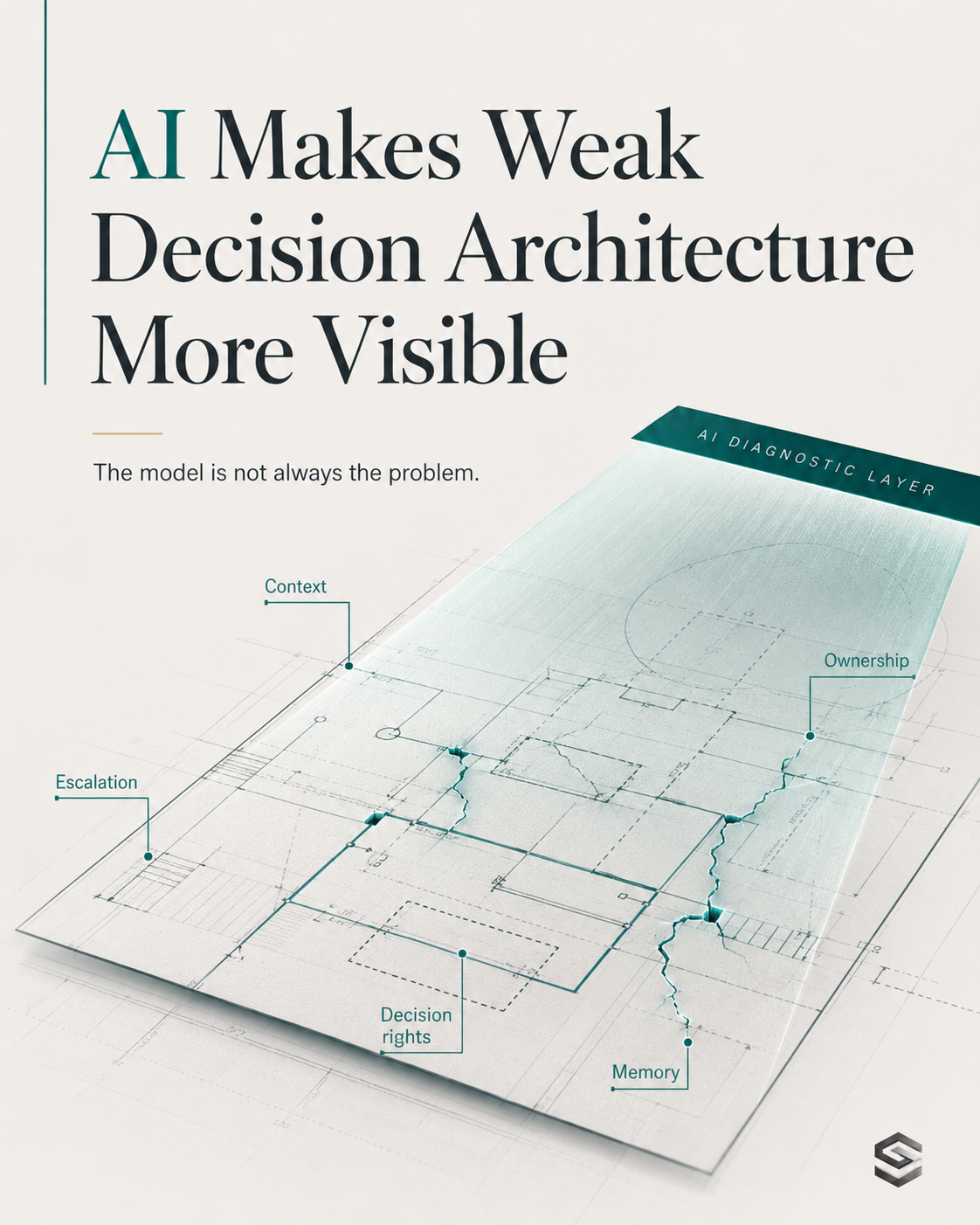
AI does not only create new organisational questions.
It also exposes old ones.
When an AI system produces more analysis, faster summaries, sharper alerts or better recommendations, the organisation still has to decide what to trust, what to challenge, what to escalate, what to ignore and who owns the consequence.
If those decision paths are already weak, AI makes the weakness more visible.
A dashboard that no one acts on becomes an AI insight no one owns. A decision that was already unclear becomes a faster recommendation without a decision right. A handoff that was already fragile becomes an automated workflow with a human still repairing the gaps. A review meeting that already avoided hard trade-offs now has more inputs but not necessarily better judgement.
This is why AI adoption is partly a decision-architecture test.
Before asking whether the AI output is good, ask what the organisation will do with it.
Who will review it? What threshold makes it actionable? What exception should stop the workflow? What human judgement remains necessary? Where will the decision be recorded? How will outcomes be used to improve the system?
AI can improve enterprise decisions only when the organisation has designed how decisions move from signal to judgement to action to learning.
Otherwise, AI may increase the supply of analysis faster than the organisation improves its ability to decide.