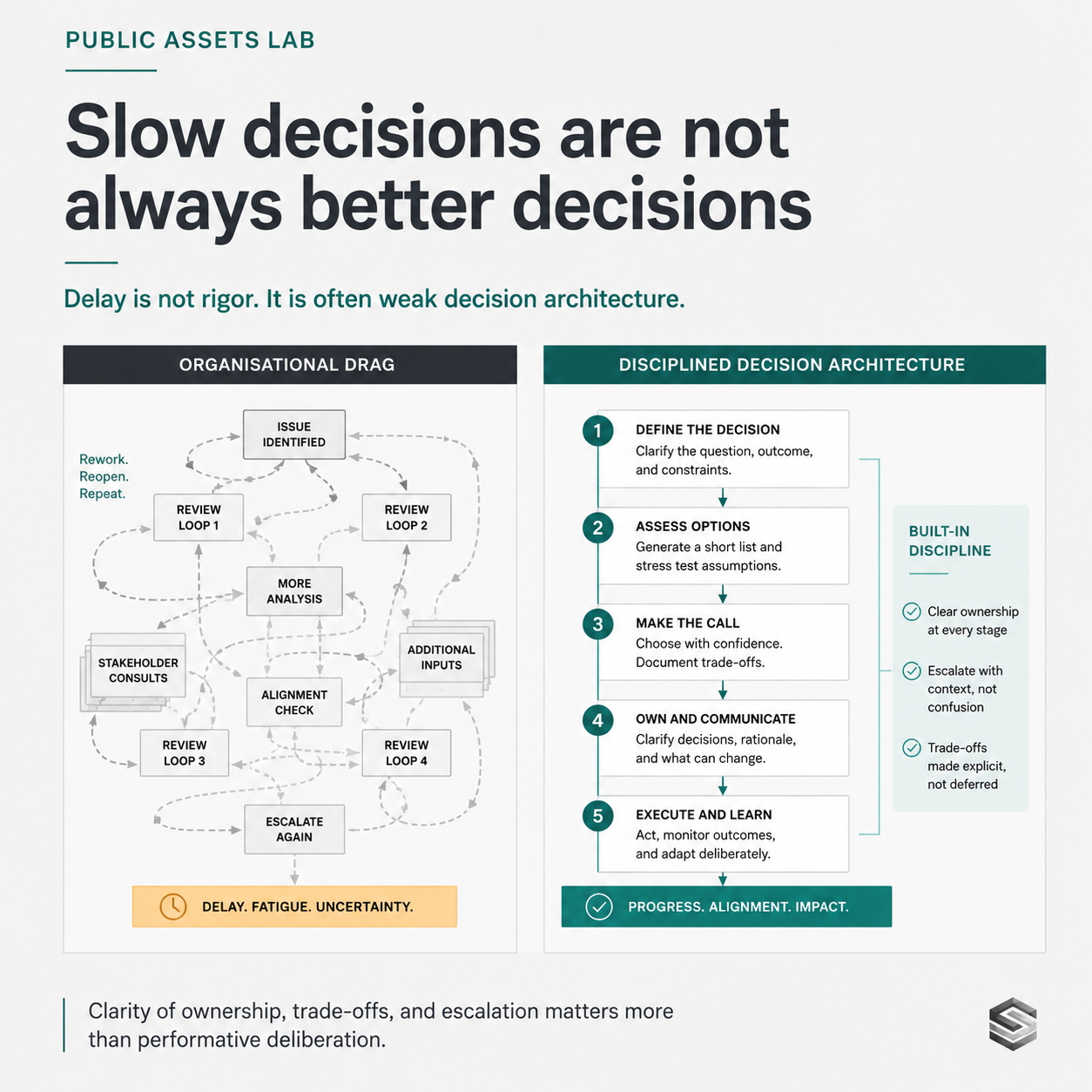
Slow decisions are not always better decisions.
In many organisations, slowness is quietly mistaken for rigour. More reviews, more alignment, more clarification and more waiting can create the appearance of seriousness.
But delay does not automatically improve judgement.
Sometimes delay helps. It gives people time to gather evidence, test assumptions, surface risk and build commitment. But sometimes delay does something else. It diffuses ownership, protects indecision, hides trade-offs and allows the decision to become weaker by the time action begins.
The real question is not whether a decision is fast or slow.
The better question is whether the decision architecture matches the nature of the choice.
Some decisions need analysis. Some need escalation. Some need experimentation. Some need a clear owner. Some need to be reversible quickly rather than perfected slowly.
When every decision travels through the same slow path, organisations pay an invisible cost. Opportunities decay. Risks compound. Teams wait for clarity. People learn that safety lies in further discussion rather than accountable movement.
Speed is not the opposite of quality. Poorly designed speed is dangerous. But well-designed decision cadence can improve quality by making evidence, ownership, escalation and learning clearer.
The useful test is:
What is the cost of waiting, and what information will waiting actually improve?