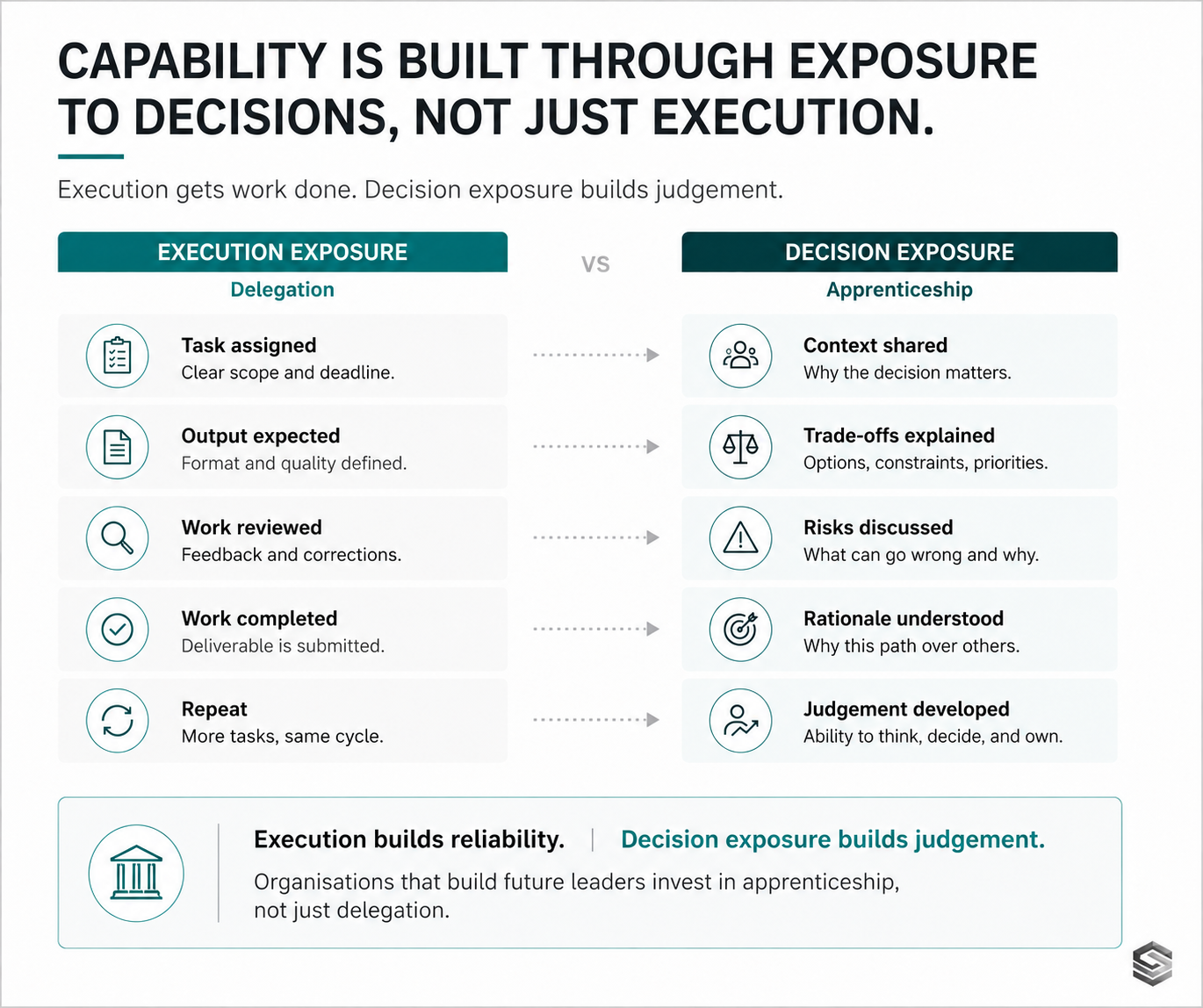
Capability is built through exposure to decisions, not just execution.
Execution exposure teaches reliability. It teaches people how to complete work, meet timelines, manage details and deliver against expectations.
But judgement develops differently.
Judgement develops when people see how decisions are framed, what trade-offs were considered, why a path was rejected, what risk was accepted, how timing mattered, and who had to own the consequence after the choice was made.
If younger professionals only receive tasks after the thinking is complete, they may become dependable executors without developing decision maturity.
This matters even more as AI removes effort from parts of the work. If drafting, summarising, analysing and comparing become faster, the danger is not only that people do less work. The danger is that they are exposed to less reasoning.
Managers therefore need to design exposure deliberately.
Invite people into the framing stage. Show them the assumptions. Explain why one recommendation was not enough. Let them observe how a decision changes when constraints, incentives and risk become visible.
The development question is not only: did the person complete the task?
It is: what decision logic did the person get exposed to while doing the work?
Execution builds reliability. Decision exposure builds judgement.