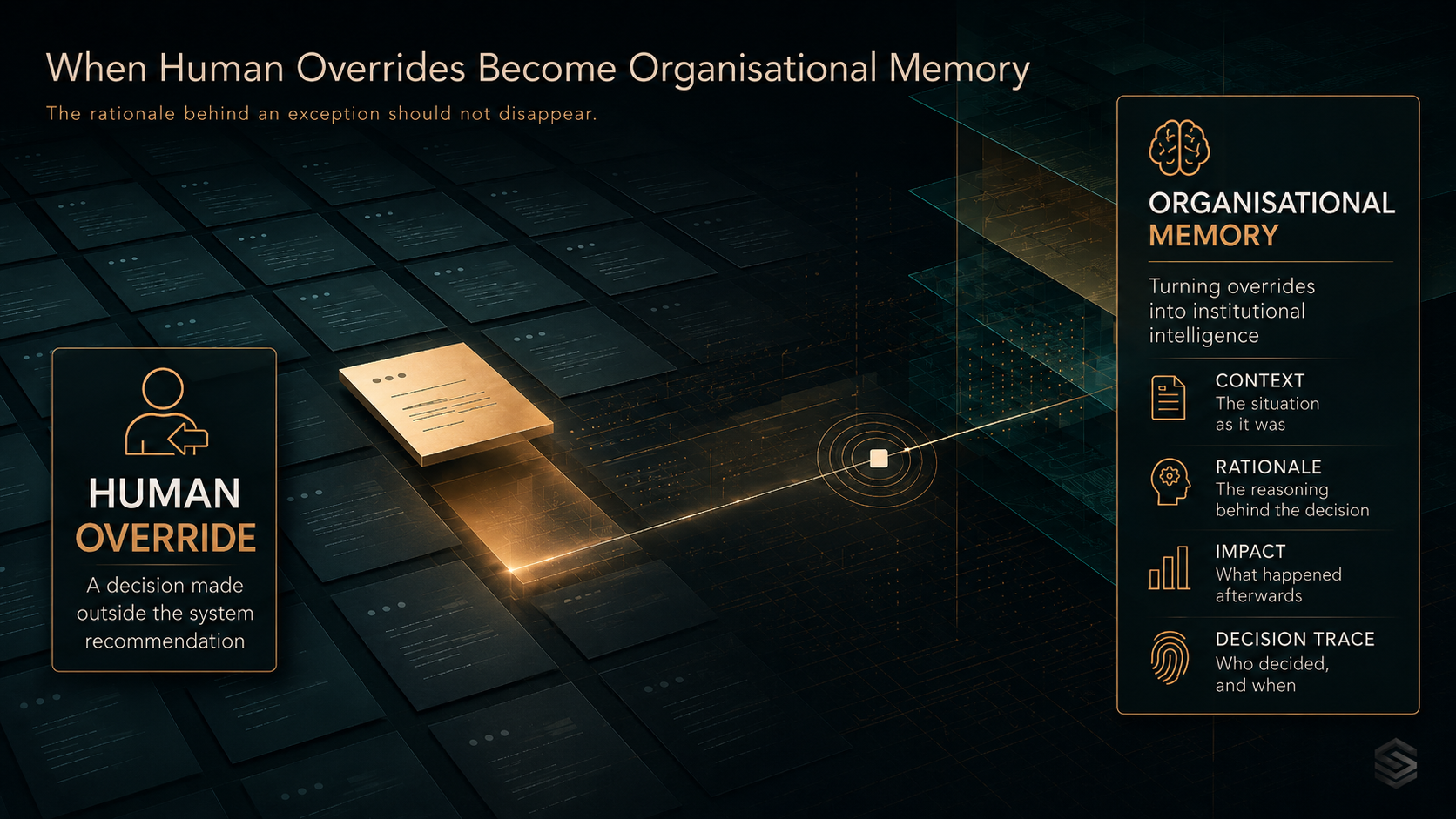
A human override in an AI workflow should not disappear as an isolated correction.
It may contain some of the most valuable decision intelligence in the organisation.
When a person rejects, changes or qualifies an AI recommendation, the important question is not only whether the human was right. The important question is why the override happened.
Was the data incomplete? Was the recommendation outside policy? Was there customer context the system did not know? Was the risk acceptable but not captured? Was the workflow forcing a binary answer where judgement required a caveat?
If the reason is not captured, the organisation loses the learning.
The next user faces the same limitation. The model is not improved. The process is not redesigned. The exception remains private knowledge inside one person’s head.
But if overrides are captured with light structure, they can become organisational memory. They can reveal failure modes, missing signals, weak policies, unclear ownership and areas where human judgement is still doing work the system cannot yet perform.
The design challenge is to capture enough rationale without creating documentation burden.
A useful override log does not need an essay. It needs the decision, the AI recommendation, the human action, the reason category, and a short note where judgement mattered.
Enterprise AI improves when human correction becomes system learning, not just manual rework.