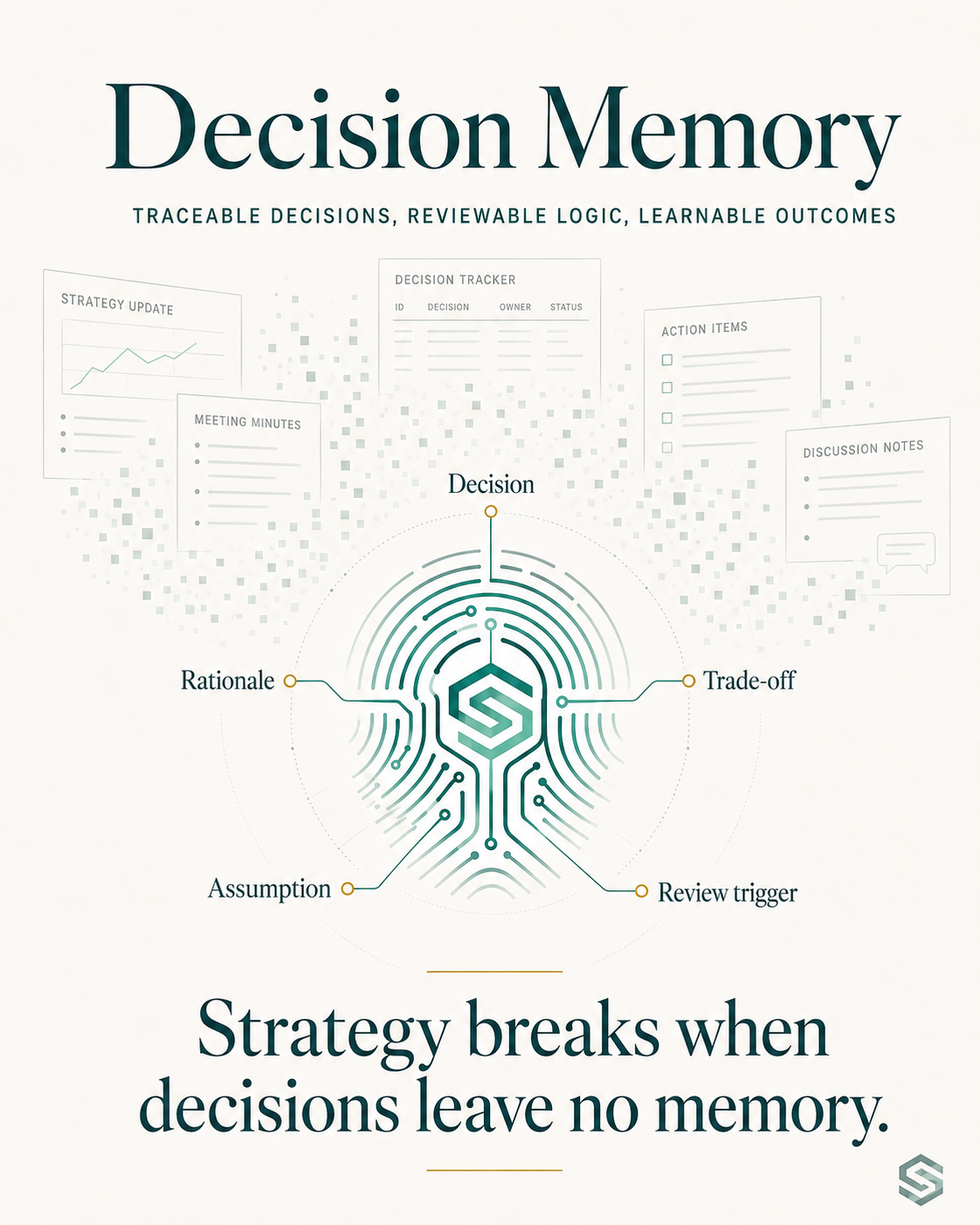
One of the most underdesigned parts of strategy work is decision memory.
Organisations spend significant time making decisions. But after the meeting, the memory of the decision often weakens.
What exactly was decided? What alternatives were considered? Which assumptions mattered? What risk was accepted? Who owned the consequence? What would make the decision worth revisiting?
If these questions are not captured, future reviews become strangely inefficient. People debate the same issue again. Context has to be reconstructed. New joiners inherit conclusions without rationale. Outcomes are judged without remembering the original trade-offs.
A decision without memory becomes difficult to learn from.
Decision memory is not just minutes of meeting. Minutes record what was discussed. Decision memory records why a choice was made, what was expected, what was uncertain and how the organisation will know whether the choice worked.
This matters even more in complex organisations where decisions travel across teams. The team executing the decision may not have been in the room where the trade-off was made.
The practical test is simple:
If we revisit this decision in three months, will we remember the logic clearly enough to learn from it?
Strategy becomes stronger when decisions are not only made, but remembered in a form that improves future judgement.