Many organisations do not suffer from a lack of strategy activity.
They have annual plans, quarterly reviews, dashboards, leadership meetings, priority lists and transformation decks.
Yet the quality of decisions does not always improve in proportion to the volume of strategy work.
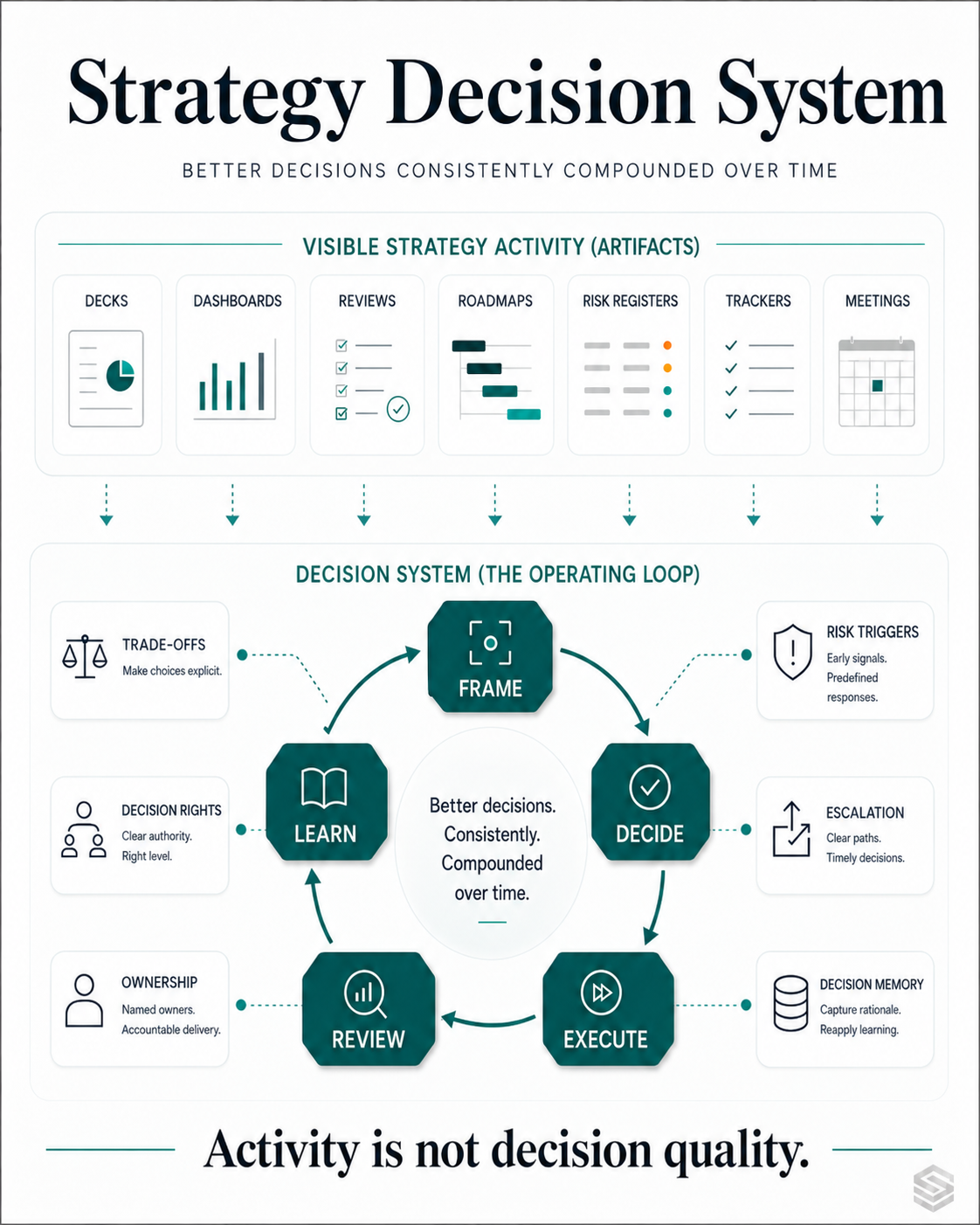
This is because strategy is often treated as an artifact-producing function, not a decision-improving system.
A strategy deck can clarify intent. A review can show performance. A dashboard can make activity visible. But none of these automatically improves how an organisation frames choices, allocates ownership, surfaces risk, remembers decisions or learns from outcomes.
The deeper question is not: do we have a strategy process?
The better question is: does our strategy system improve enterprise decisions?
A decision system makes choices explicit. It clarifies what is being decided, who owns the consequence, what evidence matters, what trade-offs are being accepted, what risks are being watched, and how the organisation will learn after action.
Without this, strategy can become a cycle of presentation, discussion and follow-up without enough decision memory or operating consequence.
The future of strategy work may not be more decks. It may be better decision architecture.