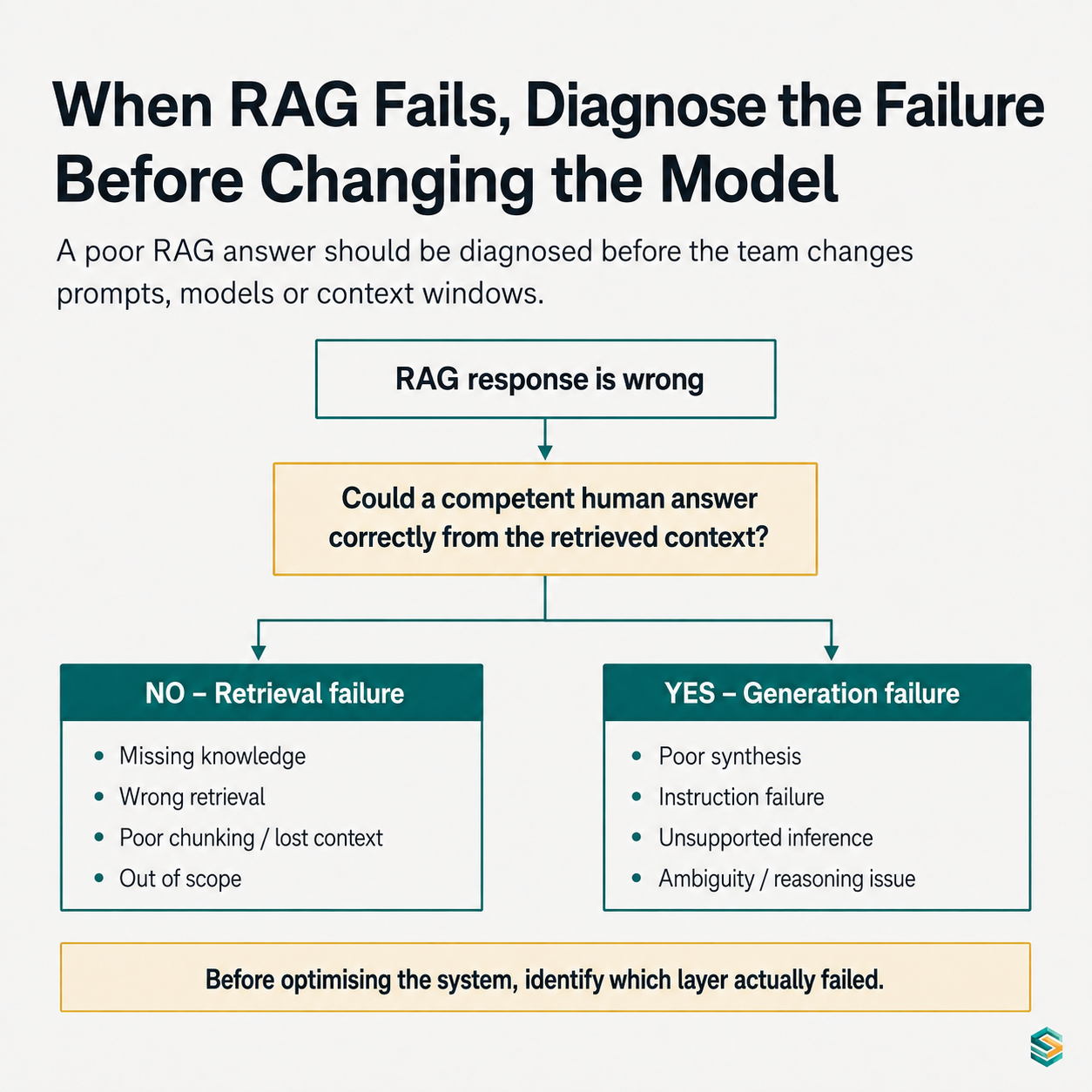
A RAG system can fail even when the model is good.
That is because many failures do not start at the generation layer. They start much earlier, when the system decides what to retrieve, how to retrieve it, and whether the retrieved context is good enough to answer.
When an enterprise AI answer is weak, the first instinct is often to blame the model. But the real failure may be different.
The relevant document may not have been indexed. The chunk may be too large or too small. The query may not match how the source material is written. The retriever may have pulled related but not decisive context. The answer may be grounded, but grounded in the wrong passage. Or the system may have failed to recognise that it should escalate rather than answer.
This is why RAG needs diagnosis, not just prompting.
A useful diagnostic sequence is:
Did the right source exist?
Was it indexed correctly?
Was the right chunk retrieved?
Was the chunk sufficient?
Did the model use it faithfully?
Should the system have refused or escalated?
Each question points to a different fix.
Better prompts may help only at the final layer. But if retrieval is noisy, incomplete or stale, the model is reasoning over the wrong evidence.
Enterprise RAG is not only a knowledge-access problem. It is a system-design problem across source governance, ingestion, retrieval, generation, evaluation and escalation.